
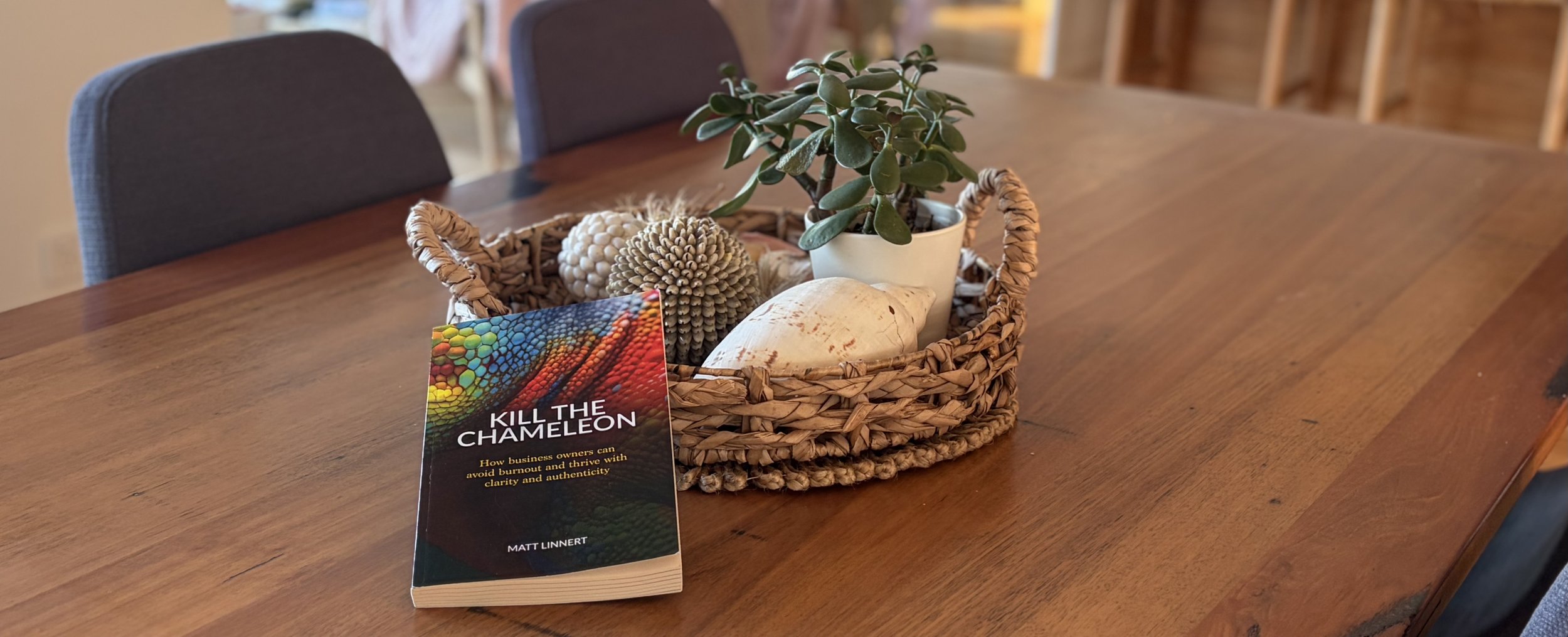

From our Kill The Chameleon chat
Some work is difficult but energising. Other work leaves us depleted, even when we’re good at it. Noticing the difference can tell us a lot about how to shape our days and our business. We can also look at the flip side of what drains us to discover what gives us energy. And these things can change over time.
Think of an activity that regularly drains you. Could you eliminate, automate, delegate or outsource some of it? If not, could you simplify it, limit how long you spend on it, or schedule it for a time when you have more capacity?
You could start by noticing what leaves you tired over the course of a week. No knee-jerk reactions, though. Take your time and look at it from a few angles. There are other reflective questions at the end of Chapter 2 that may help.
We talked about how people are generally doing the best they can with their own Pandora’s box of conditioning: upbringing, social environment, values, personality, likes, dislikes and fears.
The purpose isn’t to let people off the hook. It’s to free ourselves from some of the frustration we can carry about their behaviour. From there, it becomes easier to stay curious and learn more about their perspective.
Frustration can also tell us something about ourselves. What were you hoping for in that moment? What mattered to you that didn’t seem to matter as much to the other person?
Sometimes that insight helps us have a better conversation. Sometimes it points to a practical change, such as setting clearer expectations with a client, changing how a team works together, or reconsidering the kinds of work and relationships we keep taking on.
We also connected compassion for others with compassion for ourselves (pages 10–12, Chapter 1: Self-respect). Remember the commentary team in our heads and how harsh they can sometimes be?
3. Chapters happen
Pages 165–166 · Chapter 5: Progression
What suited you in one chapter of business or life may not suit you in another. An activity that once brought energy might now feel draining. A pace that was right when you were establishing your business may no longer be right today.
Take a look at the commitments and ways of working you’ve carried forward. Which still feel right for this chapter? Is there anything you could reduce, release or approach differently?
Changing course doesn’t mean the earlier chapter was a mistake. It may have served you well at the time. Even so, letting go of something you once depended on for success can be scary.
On page 13, I share a client’s question: “When the devil goes, will the angels go as well?” He was wondering whether he could let go of the relentless pressure he placed on himself and still be successful. I believed he could, and I’ve seen that happen many times. But it can still be a difficult transition.
Sometimes it helps to slow down and notice how a way of working feels, rather than trying to think your way through the decision straight away. If something no longer feels right, it may be worth listening to that instinct.
4. Manage your tempo
Pages 17–19 · Chapter 1: Self-respect. See also “Measured growth” on pages 91–93 in Chapter 3: Alignment.
It’s worth noticing the speed you’re trying to operate at, and what’s setting that pace. There may be genuine cashflow pressure. There may also be habits that keep you rushing even when there’s no immediate pressure.
In our conversation, I mentioned a client who changed how she began her day. She found she could still get through what mattered, but with more ease because the pace of her day suited her better.
Could you begin your day differently, leave more room between commitments, or make a clearer decision about when work finishes? Once we understand our capacity, we can make practical choices about how to design our days and our business around it. A small change to your tempo can affect how the whole week feels.
5. Acceptance
Pages 175–182 · Chapter 6: Acceptance
Acceptance can sound removed from the practical work of running a business. I see it as a starting point for making clearer decisions.
We can know that a particular kind of work drains us, that our energy has changed, or that a way of operating no longer suits us, and still keep trying to push past it. When we acknowledge what’s true, we can start asking what’s right for us now.
That reflection might confirm that our services, clients, team, working hours and expectations suit us well. Or it might show us a few things we’d like to change.
If you’ve been struggling with something, acceptance can be uncomfortable. But it gives us a clearer place to begin than denial.
It also means accepting that you have a style of your own. That style can shape how you design and deliver your services, how you talk about your work, and the people you choose to work with. It creates space for more of you to come through in your business and life.
Next Step
Pick one idea that feels relevant to you now and give it some time and thought. Notice where it shows up in your week, and be curious about the options you have.
In more than 20 years of mentoring small business owners, I’ve often seen a small tweak make a big difference. Knowing which tweak to make is usually the harder part. That’s why I’d encourage you to take your time and explore before making a knee-jerk change.
I hope this helps recap and refresh what we discussed, and gives you a few practical ways to draw on it.
If you’d like to explore further, my 6 Stages quiz is a three-minute reflection tool connected to the six chapters of the book. I also offer one-to-one mentoring around these ideas, so you’re welcome to message me if you’d like to know how that works.
And if you’d like to stay in touch, you can join my newsletter.
Thanks again for coming along. I sincerely hope the conversation was of value to you.

Thank you for joining me on Wednesday. We covered quite a bit in 45 minutes, so I wanted to put the ideas in one place and share a few ways you might explore them in your own business and life.
You don’t need to work through all five. If one resonates more, that’s a good place to begin.
And remember the deal we made. Nothing here is intended to be critical of where we’ve come from or how we’re travelling right now. We’re drawing on these insights to help us move towards a model that works for our nature, stage of life and other interests.
These are general ideas, and I haven’t considered your personal situation. If you’d like to discuss what any of them mean for you, just send me a message.
1. What drains your energy?
Pages 59–62 · Chapter 2: Clarity
2. Compassion first
Pages 119–122 · Chapter 4: Interaction
3. Chapters happen
Pages 165–166 · Chapter 5: Progression

3. Chapters happen
Pages 165–166 · Chapter 5: Progression
From Stuck to Moving
What suited you in one chapter of business or life may not suit you in another. An activity that once brought energy might now feel draining. A pace that was right when you were establishing your business may no longer be right today.
Take a look at the commitments and ways of working you’ve carried forward. Which still feel right for this chapter? Is there anything you could reduce, release or approach differently?
Changing course doesn’t mean the earlier chapter was a mistake. It may have served you well at the time. Even so, letting go of something you once depended on for success can be scary.
On page 13, I share a client’s question: “When the devil goes, will the angels go as well?” He was wondering whether he could let go of the relentless pressure he placed on himself and still be successful. I believed he could, and I’ve seen that happen many times. But it can still be a difficult transition.
Sometimes it helps to slow down and notice how a way of working feels, rather than trying to think your way through the decision straight away. If something no longer feels right, it may be worth listening to that instinct.
4. Manage your tempo
Pages 17–19 · Chapter 1: Self-respect. See also “Measured growth” on pages 91–93 in Chapter 3: Alignment.
From Overwhelmed to Composed
It’s worth noticing the speed you’re trying to operate at, and what’s setting that pace. There may be genuine cashflow pressure. There may also be habits that keep you rushing even when there’s no immediate pressure.
In our conversation, I mentioned a client who changed how she began her day. She found she could still get through what mattered, but with more ease because the pace of her day suited her better.
Could you begin your day differently, leave more room between commitments, or make a clearer decision about when work finishes? Once we understand our capacity, we can make practical choices about how to design our days and our business around it. A small change to your tempo can affect how the whole week feels.
5. Acceptance
Pages 175–182 · Chapter 6: Acceptance
From Restless to Settled
Acceptance can sound removed from the practical work of running a business. I see it as a starting point for making clearer decisions.
We can know that a particular kind of work drains us, that our energy has changed, or that a way of operating no longer suits us, and still keep trying to push past it. When we acknowledge what’s true, we can start asking what’s right for us now.
That reflection might confirm that our services, clients, team, working hours and expectations suit us well. Or it might show us a few things we’d like to change.
If you’ve been struggling with something, acceptance can be uncomfortable. But it gives us a clearer place to begin than denial.
It also means accepting that you have a style of your own. That style can shape how you design and deliver your services, how you talk about your work, and the people you choose to work with. It creates space for more of you to come through in your business and life.